
AI in Project Management: Hype vs Reality
AI is everywhere in project management conversations right now, but most of the discussion swings between two extremes: either it’s going to replace project managers entirely, or it’s just another overhyped tool that won’t stick. Reality sits firmly in the middle and if you understand that, you can get ahead of a lot of your peers.
The Shift to AI as a “Copilot”
AI is quickly becoming a “copilot” for project managers. Not a replacement, not a decision-maker, but a force multiplier. It takes over the repetitive, data-heavy, time-consuming parts of the job so you can focus on what actually moves projects forward: judgment, leadership, and stakeholder alignment.
Where AI Is Already Making an Impact
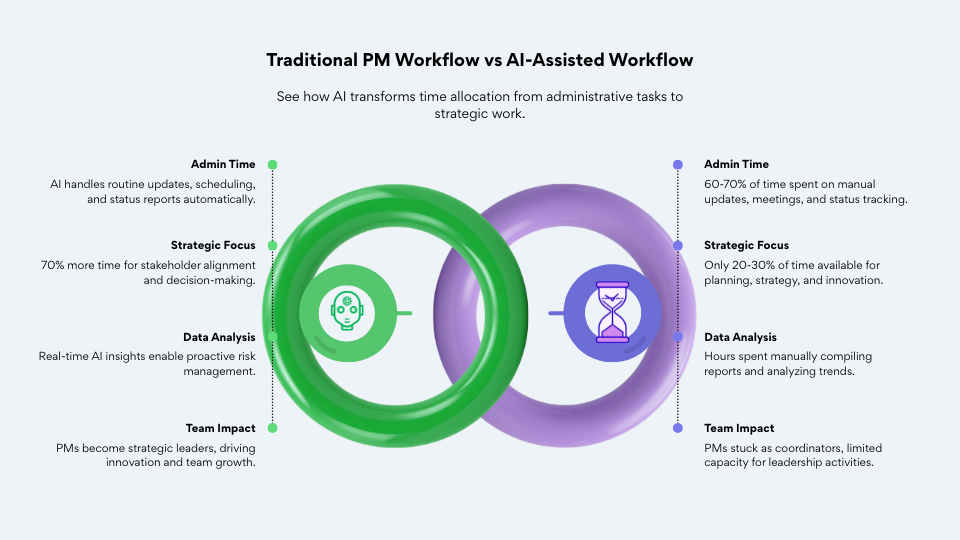
Think about where most of your time goes today. Status reports, meeting notes, schedule updates, risk logs, chasing down updates from team members. None of that is why organizations hire experienced project managers. Those tasks are necessary, but they’re not high-value. AI is starting to handle a lot of that workload with surprising effectiveness.
Automating the Administrative Burden
Take status reporting as an example. Instead of manually compiling updates from multiple sources, AI tools can now pull data from your project systems, summarize progress, highlight variances, and even draft executive-ready updates. You’re still accountable for the message, but you’re no longer starting from a blank page every week.
Why AI Won’t Replace Project Managers
Risk management is another area where AI is quietly changing the game. Traditional risk logs are reactive—they capture what you already know. AI can analyze patterns across schedules, resource allocation, and historical project data to flag risks before they fully materialize. It’s not perfect, but it gives you an early warning system that most PMs have never had before.
Then there’s meeting management, which is a notorious time sink. AI can transcribe meetings, extract action items, assign owners, and even summarize key decisions. That alone can save hours every week and reduce the risk of things falling through the cracks. More importantly, it frees you up to actually engage in the conversation instead of acting as a human note-taker.
But here’s where people get it wrong: they assume that because AI can do these things, it can do the job of a project manager. It can’t. Not even close.

What AI Still Can’t Do
AI doesn’t understand organizational politics. It doesn’t navigate difficult stakeholders. It doesn’t make judgment calls when tradeoffs get messy. It doesn’t build trust with a team that’s under pressure. Those are the moments that define whether a project succeeds or fails, and they require human experience, intuition, and leadership.
How AI Elevates the Role of the PM
What AI does is amplify your ability to operate at a higher level. It gives you better information, faster. It reduces the administrative burden that drags down your effectiveness. And it allows you to spend more time where you actually create value.
The project managers who benefit the most from AI aren’t the ones trying to automate everything. They’re the ones who are intentional about where AI fits into their workflow. They use it to draft, not decide. To analyze, not conclude. To accelerate, not replace.
There’s also a discipline required here. AI outputs are only as good as the inputs and context you provide. If you blindly trust what it generates, you’ll make mistakes. If you treat it like a junior team member—something that needs direction, review, and refinement—you’ll get far better results.
The New Expectations from Leadership
Another shift that’s happening is in expectations from leadership. Executives are starting to assume faster turnaround times, more accurate forecasting, and better visibility because AI makes those things possible. That means the bar for project managers is rising, not falling. AI isn’t making the role easier—it’s making it more demanding in a different way.
If you ignore this shift, you risk falling behind. Not because AI will replace you, but because other project managers will use it to operate more efficiently and deliver better outcomes. Over time, that gap becomes hard to close.
If you lean into it, though, you position yourself differently. You become the project manager who brings clarity faster, anticipates issues earlier, and communicates more effectively. That’s the kind of PM organizations keep and promote.
How to Start Using AI in Your Projects Today
The practical question is where to start. You don’t need a massive transformation. Start small. Use AI to draft your next status report. Let it summarize a meeting. Ask it to analyze a risk log or suggest mitigation strategies. Pay attention to where it saves you time and where it needs correction. That feedback loop is how you build confidence and capability.
Building Your AI Copilot Playbook
Over time, you’ll develop your own playbook for using AI as a copilot. And that’s really the goal—not to chase every new tool, but to integrate the right capabilities into your workflow in a way that makes you more effective.
The future of project management isn’t AI replacing people. It’s project managers who know how to use AI outperforming those who don’t.
#ProjectManagement #PMTools #BusinessSoftware #WorkflowAutomation #ProductivityTools #SaaS #ProjectPlanning
\