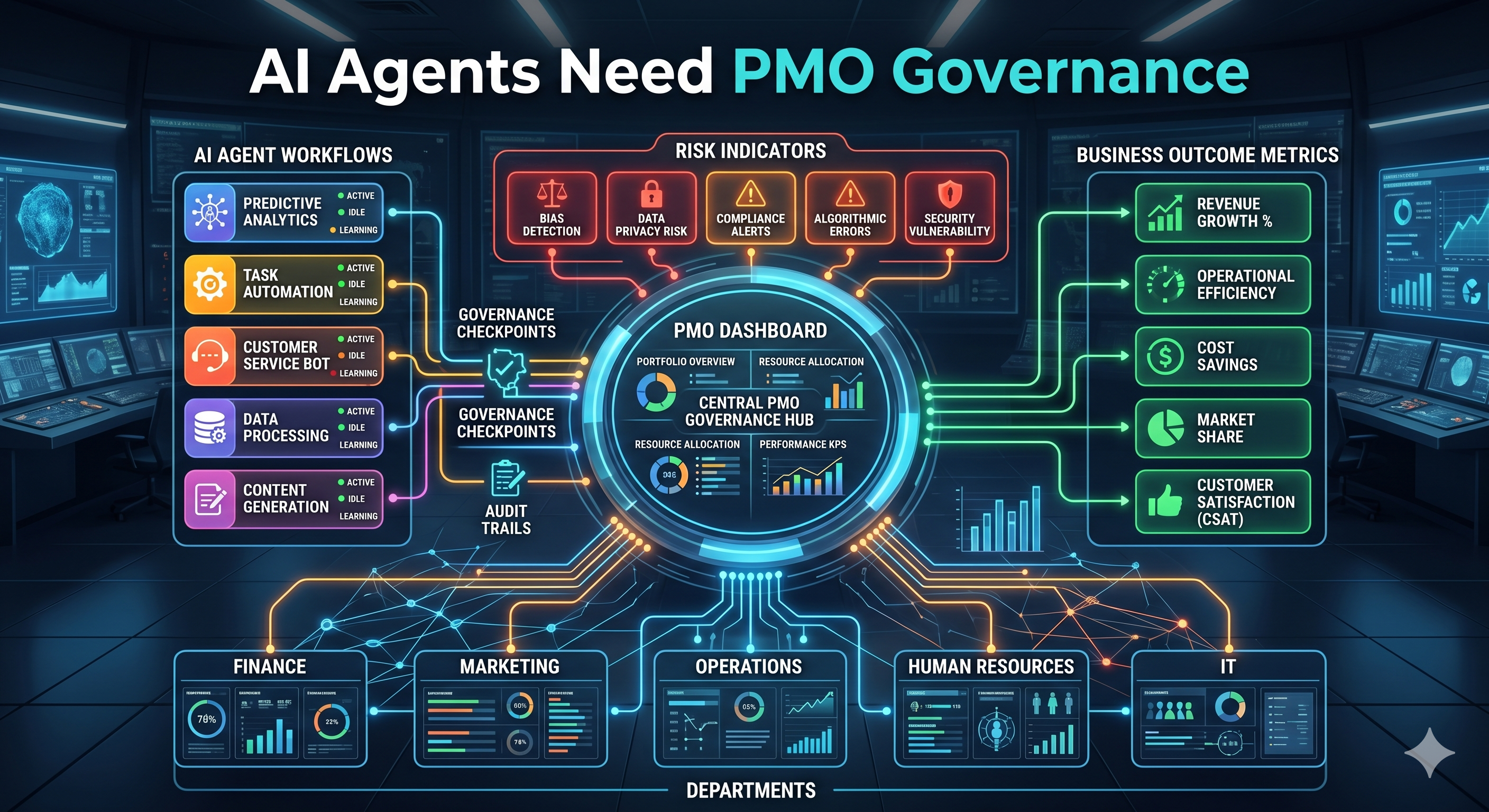
For the last two years, many organizations have treated AI as an experimentation lane. Teams tested prompts, licensed tools, launched pilots, automated small workflows, and explored what generative AI might do for productivity.
That phase is ending.
AI is now moving into operational workflows. Not just chatbots. Not just drafting support. AI agents are beginning to coordinate tasks, trigger actions, interact with systems, summarize data, route requests, support decisions, and in some cases initiate work across business processes.
That changes the management problem.
When AI is experimental, the question is, “Can this tool help us?”
When AI enters live operations, the question becomes, “Who governs the work?”
That is where the PMO becomes critical.
AI Governance Is No Longer Just an IT Issue
Most organizations initially place AI governance under IT, cybersecurity, legal, compliance, or data leadership. That makes sense. AI introduces real risks around data protection, system access, intellectual property, accuracy, bias, privacy, regulatory exposure, and vendor management.
But once AI starts affecting how work gets executed, governance has to move beyond policy.
The organization needs operating discipline.
That includes:
- Which AI use cases are approved
- Who owns each AI-enabled workflow
- What decisions AI can and cannot make
- Where human review is required
- What evidence must be retained
- How exceptions are escalated
- How benefits are measured
- How risks are monitored after launch
- How changes are controlled over time
That is not just a technology policy problem. That is a portfolio, program, project, and change management problem.
In other words, it is PMO territory.
The New Governance Gap: Work Is Changing Faster Than Oversight
The biggest risk I see is not that AI will suddenly replace every process. The bigger risk is that AI will quietly become embedded in work before the organization has updated its governance model.
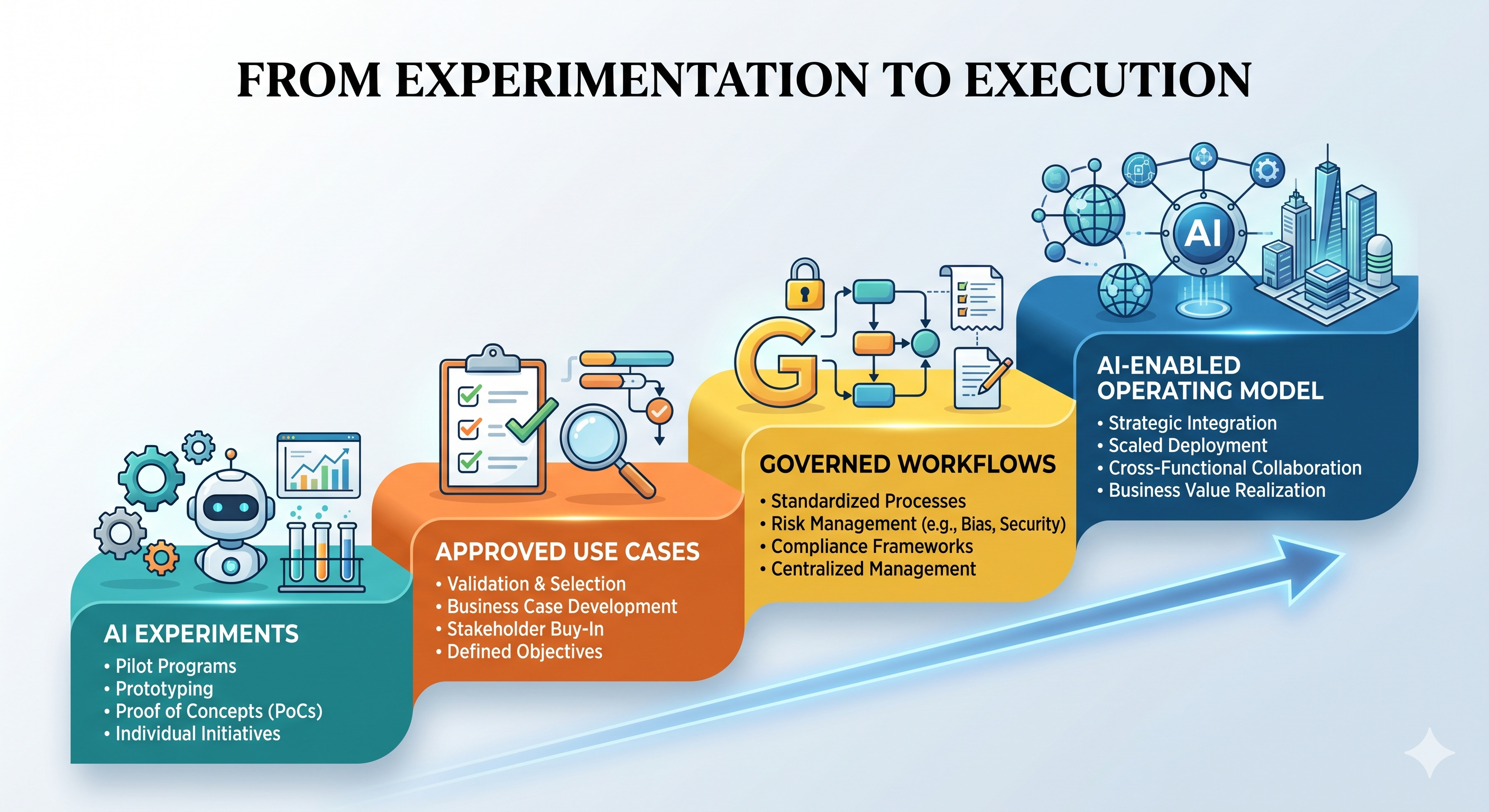
That creates several problems.
First, decentralized adoption leads to inconsistent standards. One department may use AI carefully with approved tools and documented controls. Another may use unapproved tools with sensitive information and no review.
Second, ownership becomes unclear. If an AI-generated recommendation leads to a bad customer decision, failed compliance step, project delay, or incorrect report, who is accountable? The business owner? IT? The vendor? The person who clicked approve?
Third, costs can get away from leadership. AI usage may look inexpensive during pilot testing, then become expensive when usage scales, integrations expand, and multiple teams adopt overlapping tools.
Fourth, benefits become hard to prove. Many AI initiatives promise productivity, but few organizations define measurable before-and-after outcomes clearly enough to know whether the initiative actually improved speed, quality, cost, risk, or customer experience.
Fifth, change management gets underestimated. AI changes roles, handoffs, review points, decision rights, and employee confidence. If people do not trust the system, understand the process, or know when to intervene, adoption stalls.
This is exactly the kind of complexity a modern PMO should help manage.
From Project Tracking to AI Operating Governance
Traditional PMOs often focus on schedules, budgets, status reports, risk logs, governance meetings, and project standards. Those still matter. But AI-enabled transformation requires the PMO to operate at a higher level.
The PMO should help the organization answer five practical questions.
- Are we solving the right business problem?
AI should not be treated as the strategy. AI is a capability that should support a business outcome. Before approving an AI initiative, leaders should be clear about the problem being solved, the process being improved, the decision being supported, and the value being targeted.
If the business case is vague, the AI use case is not ready.
- Who owns the process once AI is introduced?
Every AI-enabled workflow needs a named business owner. That owner should be accountable for performance, controls, user adoption, exception handling, and continuous improvement.
The PMO can help ensure ownership is defined before implementation begins, not after something goes wrong.
- What level of autonomy is appropriate?
Not every AI use case needs the same level of control. Some AI tools should only draft or summarize. Others may recommend actions. Others may trigger workflow steps. A few may operate with limited autonomy inside defined boundaries.
The organization needs a simple autonomy model that defines what AI can do, what requires human approval, and what AI is never allowed to do.
- How will we measure value and risk?
AI initiatives need more than delivery milestones. They need operational success measures.
Useful measures may include cycle time reduction, error reduction, service-level improvement, rework reduction, cost avoidance, employee adoption, customer impact, compliance performance, exception volume, and quality of outputs.
The PMO should also track risk indicators, not just benefits.
- How will the change be sustained?
AI implementation is not complete when the tool goes live. Models change. Vendors change. Regulations change. Business processes change. Employees find new uses. Risks emerge over time.
A modern PMO should help create review routines for AI-enabled processes so governance continues after launch.
The PMO as the Bridge Between Strategy, Technology, and Adoption
The reason the PMO matters is simple: AI-enabled transformation cuts across organizational boundaries.
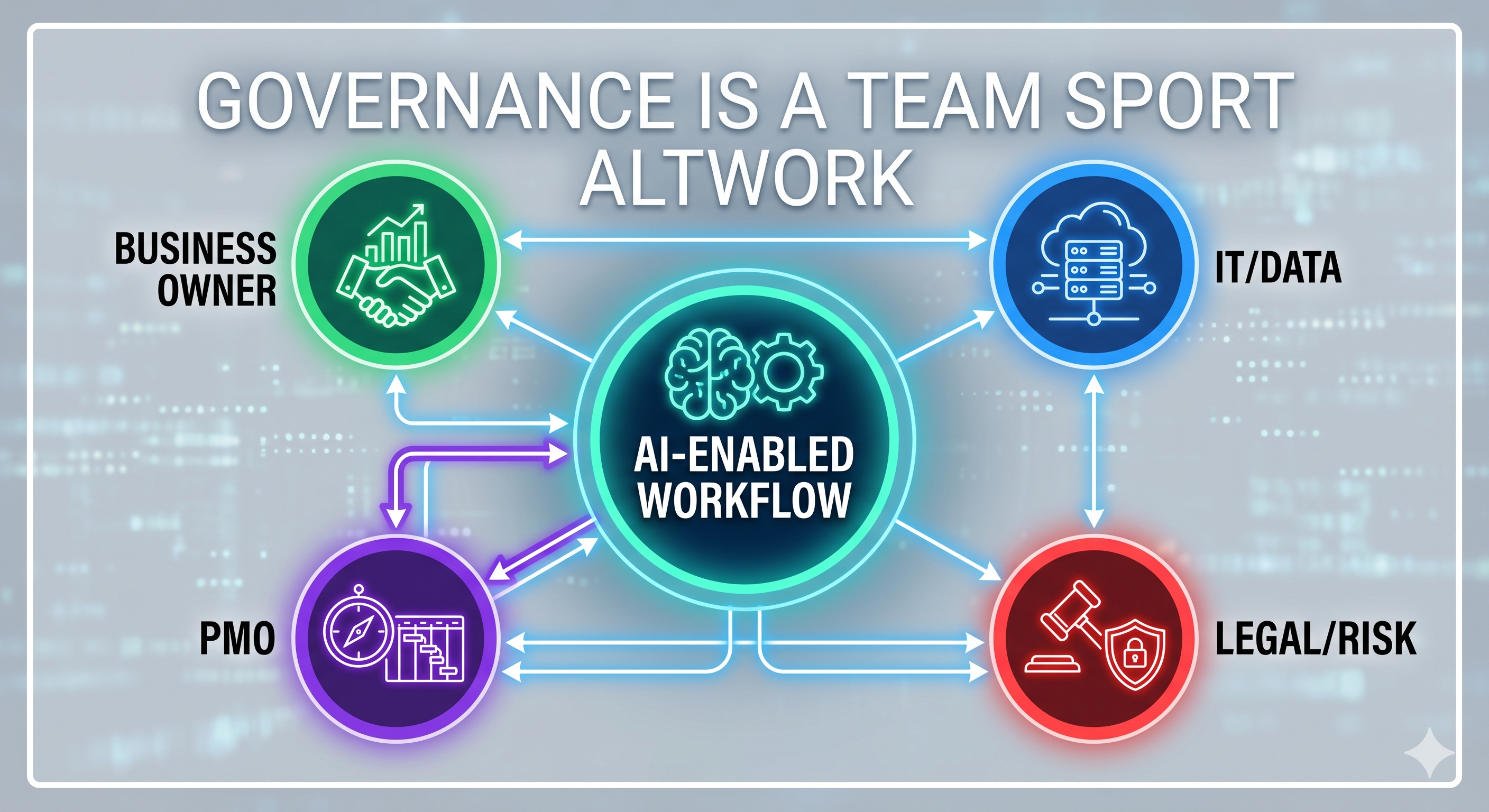
IT may understand the architecture.
Legal may understand the regulatory exposure.
Cybersecurity may understand the access risks.
Business leaders may understand the operational need.
Employees may understand the practical workarounds.
But someone has to connect these pieces into an executable operating model.
That is the role of the modern PMO.
The PMO does not need to become the AI police. It should become the coordination engine that helps leadership move from scattered AI activity to governed AI execution.
That means building practical mechanisms such as:
- AI initiative intake
- Use case scoring
- Portfolio prioritization
- Risk and value classification
- Decision-rights mapping
- Human-in-the-loop requirements
- Deployment readiness checklists
- Change impact assessments
- Adoption plans
- Benefits realization tracking
- Post-implementation governance reviews
The PMO should make AI governance usable, repeatable, and tied to business outcomes.
What Leaders Should Do Now
Organizations do not need to create a massive bureaucracy around AI. In fact, that would slow adoption and frustrate teams.
What they need is lightweight, consistent governance that scales with risk.
Here is where I would start.
First, inventory active AI use cases. Do not limit the review to enterprise-approved tools. Find out where AI is already being used in projects, operations, reporting, customer support, software development, analysis, and administrative work.
Second, classify use cases by risk and autonomy. A tool that summarizes public meeting notes does not need the same oversight as an AI agent that accesses internal systems or supports compliance decisions.
Third, assign clear business ownership. Every AI-enabled workflow should have a business owner, technical owner, and governance path.
Fourth, define human review points. Leaders should know where human judgment is required, especially for high-impact decisions.
Fifth, connect AI initiatives to the transformation portfolio. If AI projects are competing for resources, changing processes, affecting roles, or creating operational risk, they belong in the portfolio conversation.
Sixth, measure outcomes after launch. Productivity claims are not enough. Measure whether the work actually improved.
The Bottom Line
AI agents will force organizations to modernize more than their technology. They will have to modernize how work is governed.
That is an opportunity for the PMO.
A strong PMO can help organizations avoid random acts of AI, reduce risk, prioritize the right opportunities, manage change, and create a bridge between innovation and operational accountability.
The organizations that win with AI will not be the ones that adopt the most tools. They will be the ones that build the clearest operating model for using those tools responsibly.
AI may be the catalyst.
Governance will be the differentiator.