For the last several years, organizations have focused heavily on AI capability.
- What model should we use?
- Which platform is best?
- Can AI summarize documents?
- Can it write code?
- Can it automate customer service?
- Can agents complete multi-step work?
Those questions still matter, but they are no longer enough.

The more important question now is this:
How do we control AI-enabled work at scale?
That question is becoming urgent because AI adoption is moving beyond individual productivity. Organizations are no longer just giving employees access to chat tools. They are deploying copilots, integrating models into workflows, experimenting with agents, and connecting AI to enterprise systems.
Once AI can access data, call tools, trigger actions, support decisions, and coordinate work across systems, the management challenge changes.
AI becomes part of the operating environment.

That means organizations need more than a collection of tools. They need a control layer.
In technology terms, this is often described as an AI control plane, model harness, gateway, or governance layer. The language may vary, but the business need is the same. Leaders need visibility into where AI is being used, what it can access, what actions it can take, how much it costs, what risks it creates, and whether it is delivering value.
That sounds very technical.
But it is also a project management issue.
In many ways, the AI control plane is becoming the new PMO control tower.
A traditional PMO control tower helps leadership see project status, schedule risk, budget exposure, dependencies, issues, decisions, resources, and benefits. It gives the organization a structured way to manage delivery.
AI-enabled work now needs the same discipline.
The first reason is visibility.
Many organizations do not have a complete view of their AI use cases, pilots, agents, vendors, integrations, costs, and business owners. Without visibility, governance becomes reactive. Leadership cannot manage what it cannot see.
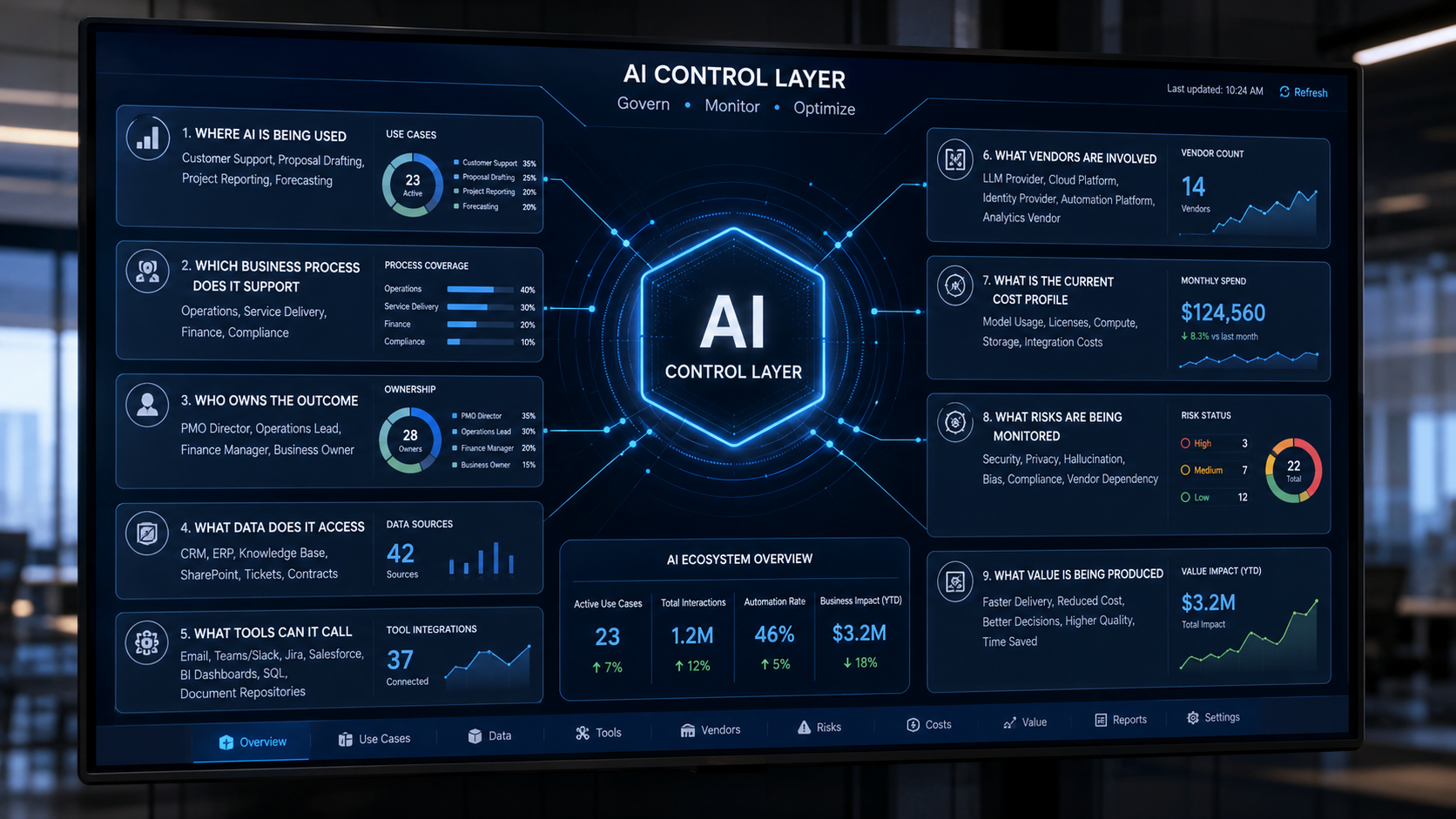
A modern AI control layer should help answer practical questions:
- Where is AI being used?
- Which business process does it support?
- Who owns the outcome?
- What data does it access?
- What tools can it call?
- What vendors are involved?
- What is the current cost profile?
- What risks are being monitored?
- What value is being produced?
Those questions belong in the PMO conversation because they directly affect delivery, risk, budget, and benefits realization.
The second reason is accountability.
AI agents can perform work, but they cannot own business accountability. A human leader still has to be responsible for the outcome. That is a critical operating model principle.
If AI supports project reporting, the delivery organization must still own the report. If AI assists customer service, operations must still own the customer experience. If AI supports financial analysis, finance must still own the decision. If AI participates in software delivery, technology leadership must still own quality and release risk.
The control plane should make that accountability visible.
The third reason is policy enforcement.
AI governance cannot live only in a PDF policy document. Policies must be translated into actual operating controls. Which data can be used? Which tools are approved? Which actions require human review? Which outputs need validation? What escalation path applies when an AI-enabled workflow fails?
This is where AI governance becomes real.
The fourth reason is cost control.
AI costs can become unpredictable, especially when agents perform repeated actions, call multiple tools, use different models, or operate across large datasets. Organizations need to monitor consumption by use case, vendor, model, team, and business value.
Cost governance is not just a finance problem. It is a delivery control problem.
If a project is consuming AI resources without measurable value, the PMO should know. If an agent scales usage beyond the original business case, leadership should know. If multiple teams are buying overlapping AI capabilities, portfolio governance should catch that.
The fifth reason is resilience.
AI vendor dependency is becoming a serious operational concern. As organizations build workflows around third-party models and platforms, they need to understand what happens if a provider changes terms, limits access, suffers an outage, increases pricing, or creates a compliance concern.
A mature AI operating model should include vendor risk, fallback options, portability considerations, and business continuity planning.
Again, this is not only a technical issue.
It is an operational resilience issue.
The sixth reason is benefits realization.
Organizations are still struggling to prove AI value. Many can point to pilots, demos, and usage metrics. Fewer can show measurable business outcomes.
The AI control plane should connect AI activity to business value.
- Did cycle time improve?
- Did manual work decrease?
- Did risk visibility improve?
- Did customer response accelerate?
- Did project reporting become more accurate?
- Did software delivery improve?
- Did costs decline?
- Did quality increase?
If AI cannot be connected to measurable outcomes, it is difficult to justify scaling.
This is why PMO modernization matters.
The PMO of the future should not only track traditional project performance. It should also help govern AI-enabled transformation. That does not mean the PMO becomes the owner of every AI platform or model. It means the PMO helps connect technology adoption to business execution.
That includes intake discipline, business case review, ownership clarity, risk tracking, decision management, cost visibility, adoption planning, and value measurement.
A practical AI control tower model should include:
- An AI use case inventory.
- A business owner for every AI initiative.
- Defined decision rights.
- Approved tools and vendors.
- Data access rules.
- Human review requirements.
- Cost thresholds.
- Risk and issue tracking.
- Vendor dependency mapping.
- Adoption and training plans.
- Benefits realization metrics.
- Post-launch performance reviews.
None of this is bureaucracy for its own sake.
It is how organizations scale AI without losing control.
The companies that succeed with AI will not simply be the ones with the most advanced models. They will be the ones with the strongest ability to govern, integrate, monitor, and improve AI-enabled work.
That is where project management consultants and PMO leaders can create real value.
AI may be the engine.
But organizations still need a control tower.
And increasingly, that control tower will look like a modern PMO built for the agentic enterprise.