AI in Project Management: A New Tool for Project Recovery, But Leadership Still Reigns Supreme
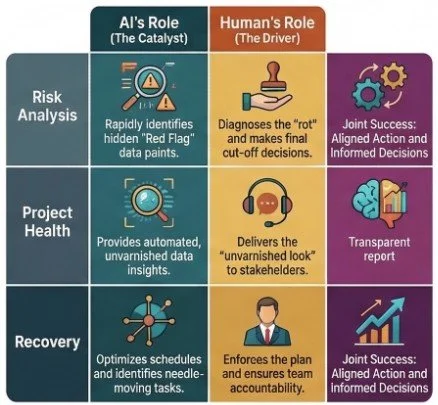
AI enhances the project rescue process primarily by accelerating the diagnosis of a failing project and amplifying the detection of threats. During the "red-flag risk analysis" phase of a project rescue, Generative AI can rapidly surface hidden risks and process massive amounts of data that might take a human weeks to compile.
The landscape of project management is evolving rapidly, driven by the integration of Artificial Intelligence. From new professional certifications like the PMI Certified Professional in Managing AI (PMI-CPMAI) to AI-powered project management coaches like PMI Infinity, the industry is embracing AI as a catalyst for transformation. However, as organizations invest heavily in complex enterprise systems, a critical question arises: how does AI actually impact project management, and more importantly, can it save a failing project?
The Rise of AI in Project Management
The Project Management Institute (PMI) has recognized Generative AI (GenAI) as a fundamental shift in how projects are delivered. GenAI is not just about automating administrative tasks; it is actively shaping agility and enabling breakthroughs.
In agile environments, GenAI strengthens teams by supporting trust, enhancing human-centered collaboration, and crucially, surfacing risks before they derail an initiative. Tools like PMI Infinity™ serve as dedicated coaches designed to boost overall project success. Furthermore, industry thought leaders emphasize that while AI is evolving project management, the human element remains central to navigating these changes effectively.
The Anatomy of Project Failure
Despite the advent of AI and advanced software platforms like Salesforce, ServiceNow, or Snowflake, organizations still frequently face the "expensive silence" of implementation failure. Budgets drain, go-live dates vanish, and executives often reflexively blame the software vendor.
However, the hard truth is much simpler: "Projects fail not because of technology, but because of poor execution and leadership".
Technology, whether it is a traditional cloud infrastructure or a cutting-edge GenAI tool, is merely a tool, not a savior. Without a seasoned leader—such as a Project Management Professional (PMP) or Agile Certified Practitioner (ACP)—capable of managing stakeholder alignment and executing with accountability, even the most advanced platforms will collapse under their own weight.
Project Recovery in the Age of AI
When a high-stakes project stalls, recovering it is not a matter of simply plugging in a new AI tool. Project rescue is a specialized discipline, not an afterthought.
Successful project recovery requires an aggressive, structured intervention. For example, an "Executive Project Rescue" typically involves a rapid three-week triage designed to deliver:
A Red-Flag Risk Analysis: Identifying the precise points of failure.
A Project Health Report: Providing an unvarnished look at the initiative's current state.
Schedule Recovery and Priority Realignment: Creating a realistic path forward that focuses only on tasks that move the needle.
This is where the intersection of AI and project recovery becomes incredibly powerful. While a veteran consultant must step into the high-pressure environment to "diagnose the rot and cut it out," GenAI can be utilized during the red-flag risk analysis phase to rapidly surface hidden risks and process data that might take a human weeks to compile. AI amplifies the project manager's ability to spot threats early, but it is the human executive who must enforce the schedule recovery plan and realignment.
The Bottom Line: Execution Over Algorithms
Mid-size businesses and government agencies alike need agility and specialized expertise to maximize their software investments, rather than relying on the bloated overhead of "Big Four" global agencies. AI tools can provide lightweight governance frameworks, actionable insights, and process optimization support, but they cannot replace the tactical discipline of a veteran leader.
As you evaluate your current project portfolio, remember this critical takeaway: If your project were to fail tomorrow, it wouldn't be because the software or the AI didn't work—it would be because no one was truly leading the charge. Embrace AI to surface risks and amplify collaboration, but rely on specialized, veteran leadership to execute the rescue.
Why the "Big Firm" Approach is Breaking Your Tech Projects (and 5 Truths to Fix Them)
The Expensive Silence of Implementation Failure
I have seen this scenario play out across every sector, from state-level Departments of Transportation (DOTs) to mid-market ERP rollouts: an organization greenlights a six-figure investment in a platform like Salesforce or NetSuite, only to be met with an "expensive silence" six months later. The budget is draining, the "go-live" date is a ghost, and the initial excitement has been replaced by a quiet, mounting dread.
The hard truth is that the "missing link" in these high-stakes investments isn't the software, the code, or the cloud infrastructure—it is the execution leadership. As the founder of Saber Management Solutions, a veteran-owned firm, I have spent over 25 years in the trenches of enterprise technology programs. I’ve seen firsthand that a project's survival depends less on the tool purchased and more on the veteran leadership driving the implementation. Success requires more than just a vendor; it requires the structured oversight of a seasoned Project Management Professional (PMP) and Agile Certified Practitioner (ACP) who can rescue an initiative before it becomes a total loss.
Technology Isn't the Villain (Leadership Is)
When a project stalls, executives reflexively blame the software vendor. It is a convenient narrative, but in my experience rescuing failing $2M implementations, the technical limitations of the platform are rarely the root cause. Projects fail because the organizational strategy lacks the backbone of accountability.
As we maintain at Saber Management Solutions:
“Projects fail not because of technology, but because of poor execution and leadership.”
This is a bitter pill for many businesses to swallow. Technology is a tool, not a savior. Without a leader capable of stepping into a high-stakes environment with minimal onboarding to manage stakeholder alignment and risk, even the most advanced platform will collapse under its own weight. To avoid this, you must stop looking at the software and start looking at who is actually leading the charge.
The "Deloitte Gap" and the Rise of the Independent Specialist
Mid-market companies often find themselves trapped in what I call the "Deloitte Gap." They are too large for a basic "out of the box" setup, yet they are crushed by the massive overhead, bureaucratic layers, and junior-consultant churn of a global agency.
For enterprise systems like Workday or Salesforce, the "Big Four" approach often bills you for the prestige of their brand rather than the agility of their execution. A lean consulting model is the superior alternative. Independent specialists provide the same high-impact expertise as the big firms but without the administrative bloat. Whether you are navigating a Workday HRIS configuration or a NetSuite ERP rollout, you need a specialist who understands that mid-market agility is a competitive advantage, not a hurdle.
The "Project Rescue" is a Specialized Discipline, Not an Afterthought
Most firms want the "greenfield" projects where they can build from scratch. Very few have the stomach or the tactical discipline to step into a failing, high-pressure environment and execute a recovery. At Saber, we treat Executive Project Rescue as a specialized discipline.
Our three-week intervention isn't about vague suggestions; it’s about a rapid triage that delivers:
A Red-Flag Risk Analysis: Identifying the precise points of failure.
A Project Health Report: An unvarnished look at the current state of the initiative.
Schedule Recovery and Priority Realignment: A realistic, aggressive path back to the timeline that focuses only on the critical tasks that move the needle.
In a rescue scenario, you don't have time for a generalist to "get up to speed." You need a veteran who can diagnose the rot and cut it out immediately.
Niche Expertise Outperforms Generalist Knowledge
The larger the project, the more dangerous a generalist becomes. Consider AASHTOWare Project, a system used by State DOTs for critical infrastructure. These projects range from $200,000 to $2 million, involving complex module configuration and intricate business process design.
In these specialized environments, there are often only a handful of experts nationwide who truly understand the nuances of the software. Whether it is data architecture in Snowflake or ITSM workflows in ServiceNow, generalist teams will often spend your budget "learning" the system on your dime. True efficiency comes from hiring the specialist who has already mastered the niche, ensuring that the software is maximized rather than just "installed."
Operational Efficiency is a Product, Not just a Goal
Many organizations treat "operational efficiency" as a vague aspiration. This is a mistake. To see real results, you must treat process and governance as tangible products with fixed costs and defined deliverables.
The Big Four firms will happily bill you endless hourly fees for "discovery" and "analysis" with no clear end in sight. In contrast, a specialist model provides high-impact packages like our $18,500 PMO Startup Kit. This is a fixed-fee product that establishes a lightweight governance framework, reporting templates, and the necessary structure to provide instant accountability.
By utilizing Process Optimization Sprints and fixed-fee implementation oversight, mid-size businesses can achieve lightweight governance—the kind that provides structure without the suffocating red tape of a heavy bureaucratic framework.
The Future of High-Impact Execution
The modern business landscape is littered with expensive software licenses that no one knows how to use and "stalled" projects that are actually dead in the water. Success in this environment requires a departure from the high-overhead models of the past in favor of specialized, veteran-led execution.
As you evaluate your current project portfolio, I challenge you to ask one question: "If your current project were to fail tomorrow, would it be because the software didn't work, or because no one was truly leading the charge?" The software is rarely the problem. The leadership, however, usually is.