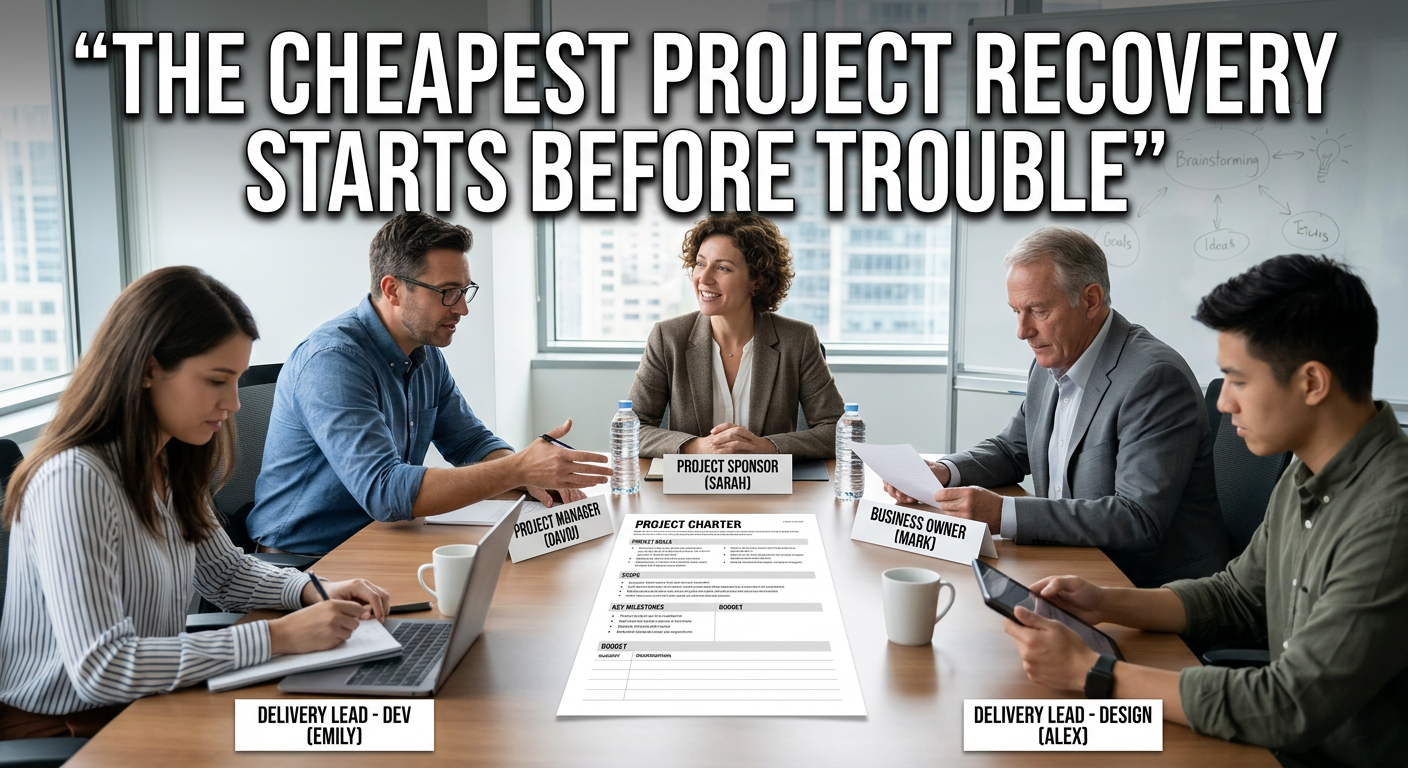
The Cheapest Project Recovery Starts Before the Project Gets in Trouble
Project recovery can be expensive.
By the time a project is officially labeled “troubled,” the organization may already be dealing with missed milestones, cost overruns, frustrated stakeholders, overworked teams, vendor conflict, and declining confidence.
That is why some of the best project recovery work happens before there is anything to recover.
It starts with clarity.
One of the simplest tools for creating that clarity is also one of the most overlooked: the project charter. Too often, the charter is treated as an administrative document. Something that gets created because the methodology says one is required. Something that gets approved at kickoff and then disappears into a shared drive.
That misses the point.
A good project charter is not paperwork. It is a leadership agreement. It establishes why the project exists, what success looks like, who has authority, who owns the outcome, what boundaries exist, and how decisions will be made.
Those are exactly the areas that become painful later when they are unclear.
Consider some of the most common symptoms of a troubled project.
- The scope keeps expanding.
- Nobody can agree on priorities.
- The project manager cannot get decisions.
- The sponsor is disengaged.
- Business owners expect outcomes that were never documented.
- Teams argue over responsibilities.
- The schedule keeps moving because assumptions were never resolved.
- Stakeholders disagree about whether the project is succeeding.
Those problems may show up months into delivery, but many of them were created at the beginning. The organization started execution before it created enough alignment.
That is why the charter should be viewed as a recovery-prevention tool.
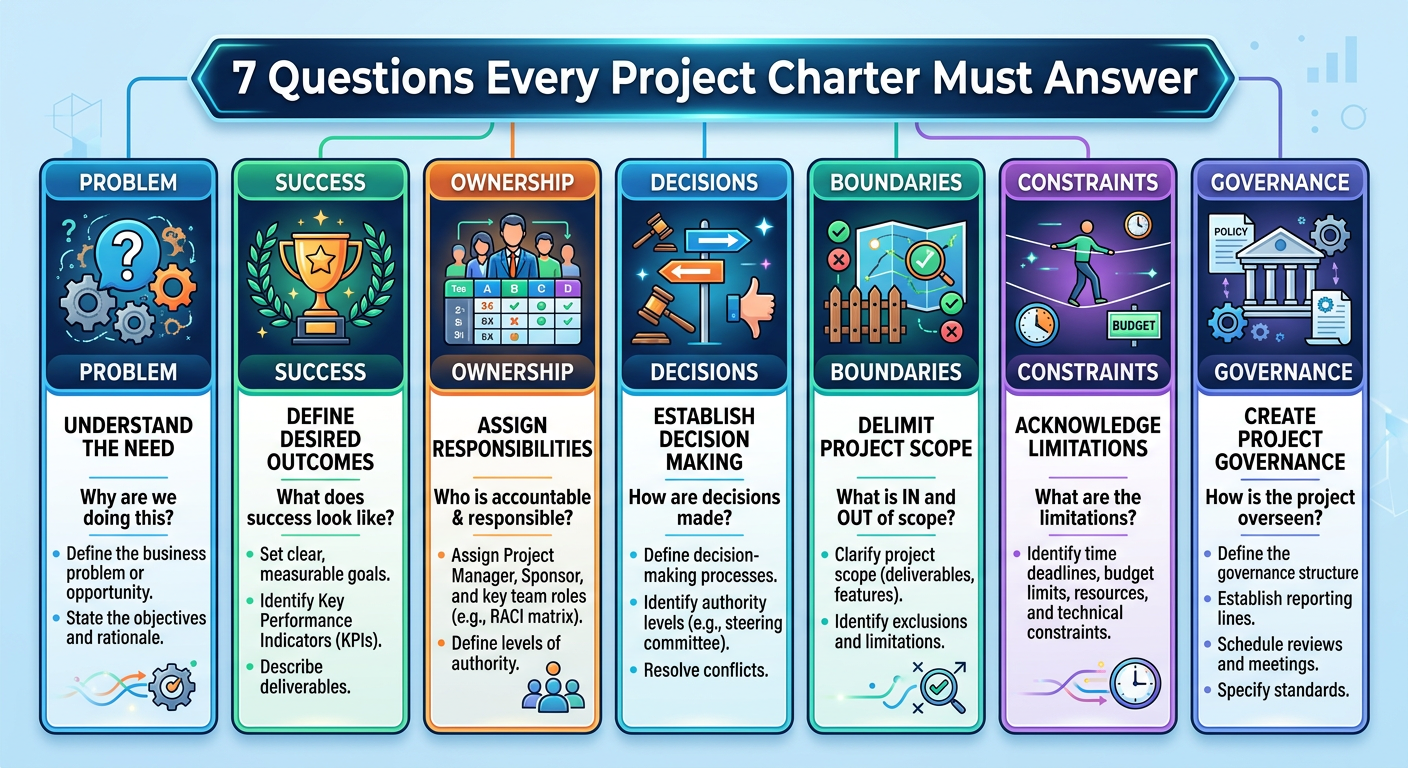
A strong charter should answer at least seven questions.
First: What problem are we solving?
Projects often begin with a solution already in mind.
- “We need a new system.”
- “We need to automate this process.”
- “We need a new customer portal.”
- “We need to consolidate these tools.”
But the solution is not the problem statement.
A good charter explains what is happening in the business today, why that condition matters, who is affected, and what measurable improvement the organization expects. If the team cannot clearly explain the problem, it will struggle to determine whether the eventual solution is actually creating value.
Second: What does success look like?
Success should be more specific than “go live.” A project can launch successfully and still fail from a business perspective. The charter should identify the outcomes that matter.
- Cycle time reduced.
- Errors decreased.
- Customer satisfaction improved.
- Reporting made faster.
- Revenue protected.
- Cost reduced.
- Compliance improved.
- Capacity increased.
A project team needs to understand what business success looks like before it can make intelligent tradeoffs during delivery.
Third: Who owns the business outcome?
The project manager owns delivery management. That does not mean the project manager owns the business outcome. Every project needs a clearly identified business owner who is accountable for whether the change actually delivers value.
Without that ownership, projects can become technology exercises, vendor implementations, or collections of tasks without strong business direction.
Fourth: Who has decision authority?
This is one of the most important charter questions.
- What can the project manager decide?
- What belongs to the business owner?
- What requires executive sponsor approval?
- What goes to the steering committee?
- What happens when a decision is delayed?
Projects lose enormous amounts of time waiting for decisions that nobody realized they were responsible for making. Decision rights should be established before they become urgent.
Fifth: What are the project boundaries?
A project charter should define what is in scope and, just as importantly, what is not. This does not mean every requirement must already be known. It means the organization should agree on the boundaries of the work. Without boundaries, almost any request can eventually become “part of the project.” That is how scope creep quietly becomes normalized.
Sixth: What assumptions and constraints matter?
Every project begins with assumptions.
- Resources will be available.
- A vendor will deliver by a certain date.
- Funding will remain available.
- A regulation will not change.
- A dependent project will finish first.
- A particular system will support an integration.
Those assumptions should be visible. When assumptions remain hidden, teams often discover them only after one turns out to be wrong.
Constraints matter just as much.
- A fixed launch date.
- Limited staff capacity.
- Regulatory deadlines.
- Budget ceilings.
- Contract obligations.
- Seasonal business restrictions.
Strong planning starts when everyone understands what cannot easily move.
Seventh: How will governance work?
A project needs more than meetings. It needs a decision system.
- How often will the sponsor review the project?
- What belongs in the steering committee?
- What conditions trigger escalation?
- How will major scope changes be approved?
- How will risks and issues be handled?
- What information does leadership need?
A project with weak governance usually does not fail all at once. It loses time one unresolved decision at a time. That is why the charter matters so much. It creates a common starting point.
But there is another important principle:
The charter should not disappear after kickoff. It should remain a living reference point throughout the project. When someone proposes a major scope change, return to the charter.
- Does it support the original business outcome?
- When stakeholders disagree about priorities, return to the charter.
- What did leadership say mattered most?
- When the schedule begins slipping, return to the charter.
- Which constraints were fixed, and which were negotiable?
When a project enters recovery, one of the first documents worth reviewing is often the original charter. It can reveal whether the project drifted away from its original purpose—or whether the original purpose was never clear enough to begin with.
For small and mid-sized businesses, this discipline is especially valuable. Smaller organizations often move quickly. That can be a competitive advantage. But speed can also mean projects start informally. Someone has a good idea. A vendor gets called. A tool is selected. A deadline is announced. And delivery begins.
The organization may skip the charter because the project feels straightforward. Then complexity appears. Departments disagree, costs increase, requirements change.
The owner becomes frustrated. The project manager becomes the messenger between competing expectations. A two-page charter at the beginning can prevent months of confusion later. It does not need to be complicated.
For many projects, a practical charter can fit on a few pages.
- Problem statement.
- Business objective.
- Success measures.
- Scope boundaries.
- Sponsor.
- Business owner.
- Project manager.
- Decision rights.
- Major assumptions.
- Major constraints.
- Governance cadence.
That is enough to create alignment. The goal is not documentation. The goal is agreement. This is an important distinction for project managers and consultants. A project charter should not simply record what people said.
Creating the charter should force the conversations that need to happen.
- What are we actually trying to accomplish?
- Who owns the result?
- What are we willing to change?
- What are we not willing to change?
- Who makes the difficult decisions?
- How will we know this project was worth doing?
Those conversations are inexpensive at the beginning. They become very expensive halfway through delivery. Project recovery will always be necessary in some situations.
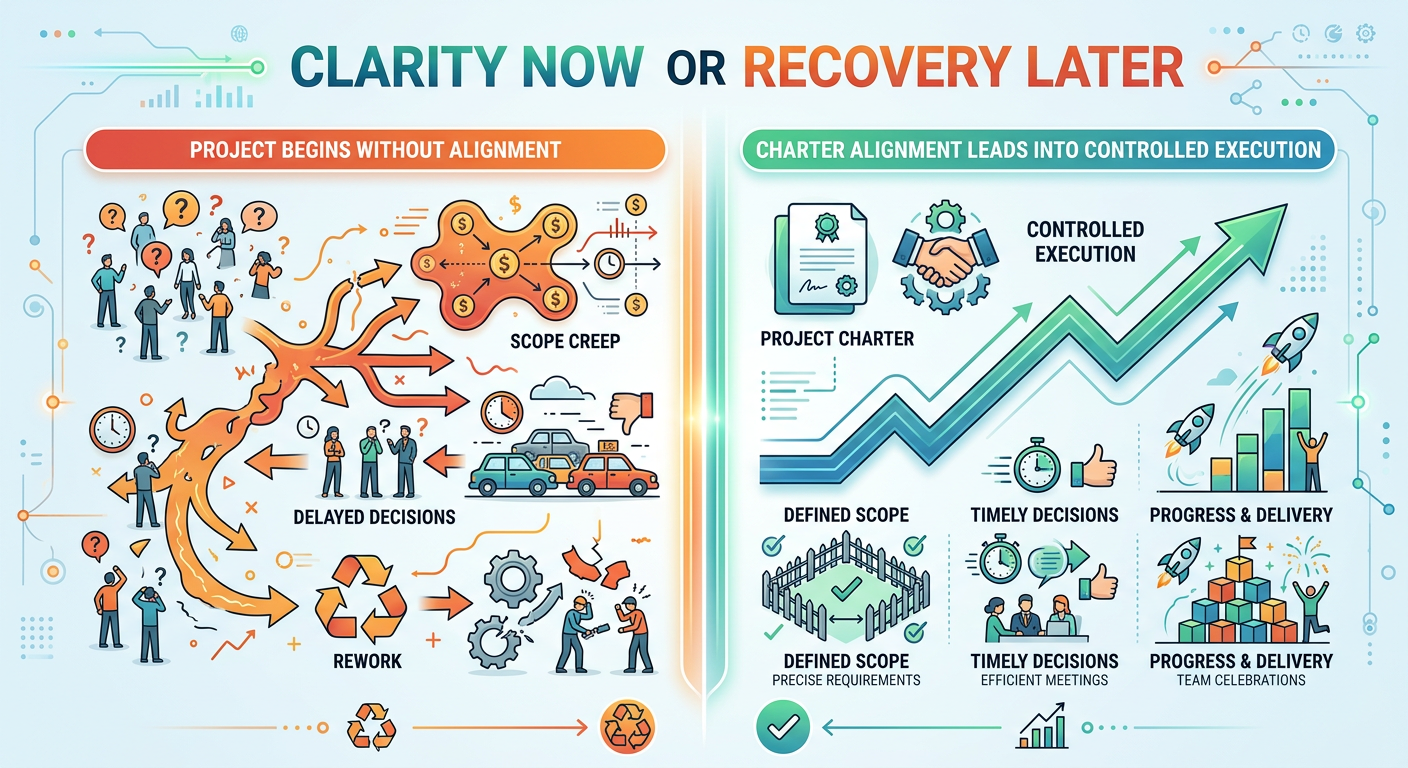
Markets change - Vendors fail - Unexpected risks appear - Priorities shift - Organizations make mistakes.
But many troubled projects are not victims of unpredictable events. They are victims of unresolved questions that were carried from initiation into execution. That is preventable.
The cheapest project recovery effort is the one you never need.
And one of the simplest ways to avoid it is to start the project with clarity. Not just a kickoff meeting. Not just a schedule. Not just a list of tasks.
A real charter.
A leadership agreement about why the project exists, who owns it, how decisions will be made, and what success actually means. That is not bureaucracy.
That is good project management.