
There’s one question project managers and small business owners hear more than any other: “How much is this going to cost?”
It’s a fair question. The trouble is that people usually want the answer before the project is defined well enough to estimate. That’s where bad estimates begin.
Someone describes a project in a few sentences. A customer wants a number. Leadership wants to know whether it fits the budget. Sales needs something for the proposal. So somebody takes a quick look, makes a few assumptions, adds up some labor, throws in a little contingency, and produces a number.
Then the number becomes real. It gets approved, it gets quoted, and it lands in a budget. Six weeks later the team finally understands what the project actually requires, and everyone is surprised the estimate was wrong.
It’s Not an Estimating Problem. It’s a Definition Problem.
You can’t produce a quality estimate for work that hasn’t been defined to a useful level. That sounds obvious, but we break that rule constantly. I’ve seen estimates built from a paragraph, from meeting notes, from a sales conversation, and from a single line like this one:
“Implement the new system.”
What exactly does that mean? Which business units are involved, and which integrations? How much data has to move, and how many users need access? What training, reporting, testing, and documentation are required? How much of the effort falls on the vendor, how much falls on your own people, and what are you assuming the customer will handle? Until those questions have answers, the number is mostly a guess with nice formatting.
A Ballpark Becomes a Budget. A Budget Becomes a Promise.
There’s nothing wrong with a rough estimate, as long as everyone understands that it’s rough. The problem starts when an early number gets treated like a commitment. The ballpark becomes the budget. The budget becomes a promise. And the promise becomes the project manager’s problem.
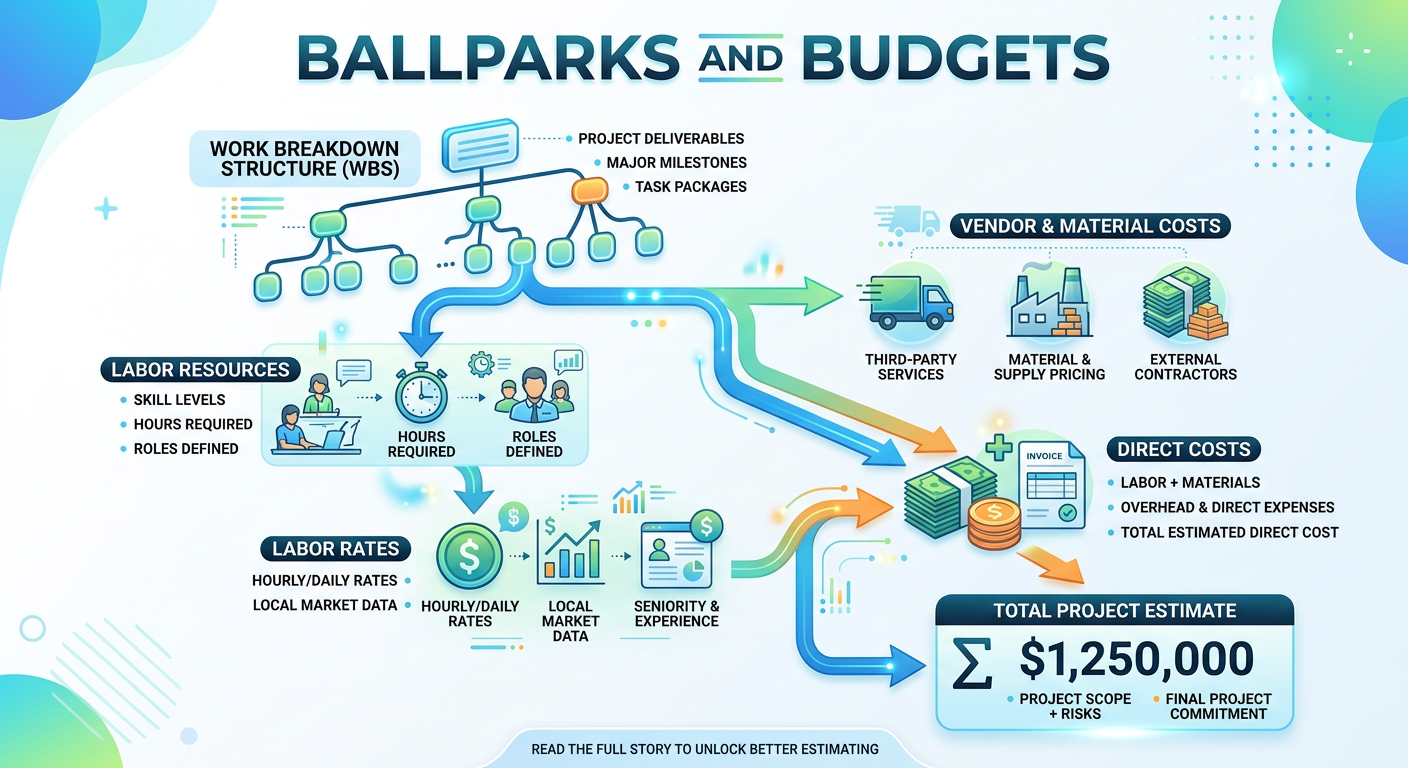
That’s why estimating has to be tied tightly to scope. The better you understand the work, the better your estimate can be.
Break It Down Before You Price It
This is where the work breakdown structure earns its keep. A WBS forces you to stop treating the project as one giant thing. Instead of a single line that reads “Website redesign: $40,000,” you start breaking the work into its real pieces: discovery, requirements, user experience, design, content migration, development, integrations, testing, training, launch, and support.
Once the work is broken down, you can ask better questions. Who’s doing each piece, and how many hours are realistic? Which labor rates apply? Are outside vendors involved, and what direct costs come with the job? What assumptions are baked in, where is the uncertainty, and where should the contingency actually live?
That’s a real estimate. Not because it’s guaranteed to be right, because no estimate is. It’s better because you can explain where every number came from.
A Good Estimate Is One You Can Defend
That distinction matters. If someone asks, “Why is this $180,000?” the answer can’t be “Because that’s what we think it’ll cost.”
You should be able to walk them through the structure of the work: here’s the labor and the rates behind it, here are the vendor costs and direct expenses, here are the assumptions we made, here’s the risk and the contingency set aside for it, and here’s exactly what is and isn’t included. Now leadership has something it can actually evaluate, challenge, and approve with confidence.
Small Businesses Can’t Afford to Miss
This matters even more for small businesses. A large company can usually survive a badly estimated project. A small consulting firm, contractor, agency, or professional services shop may not have that luxury.
Miss the estimate badly enough and you don’t just hurt the project. You eat into the margin. You tie up your people longer than planned, which pushes back the next job. You create cash-flow problems. And sometimes you end up doing work for free, because nobody wants to go back to the customer and admit the original number was wrong.
That’s why estimating isn’t an administrative exercise. It’s a business discipline.
Estimates Should Mature, Not Freeze
One of the worst estimating habits is working at the wrong level of detail. Too little detail and you miss work. Too much detail too early and you waste time estimating things the team doesn’t understand yet.
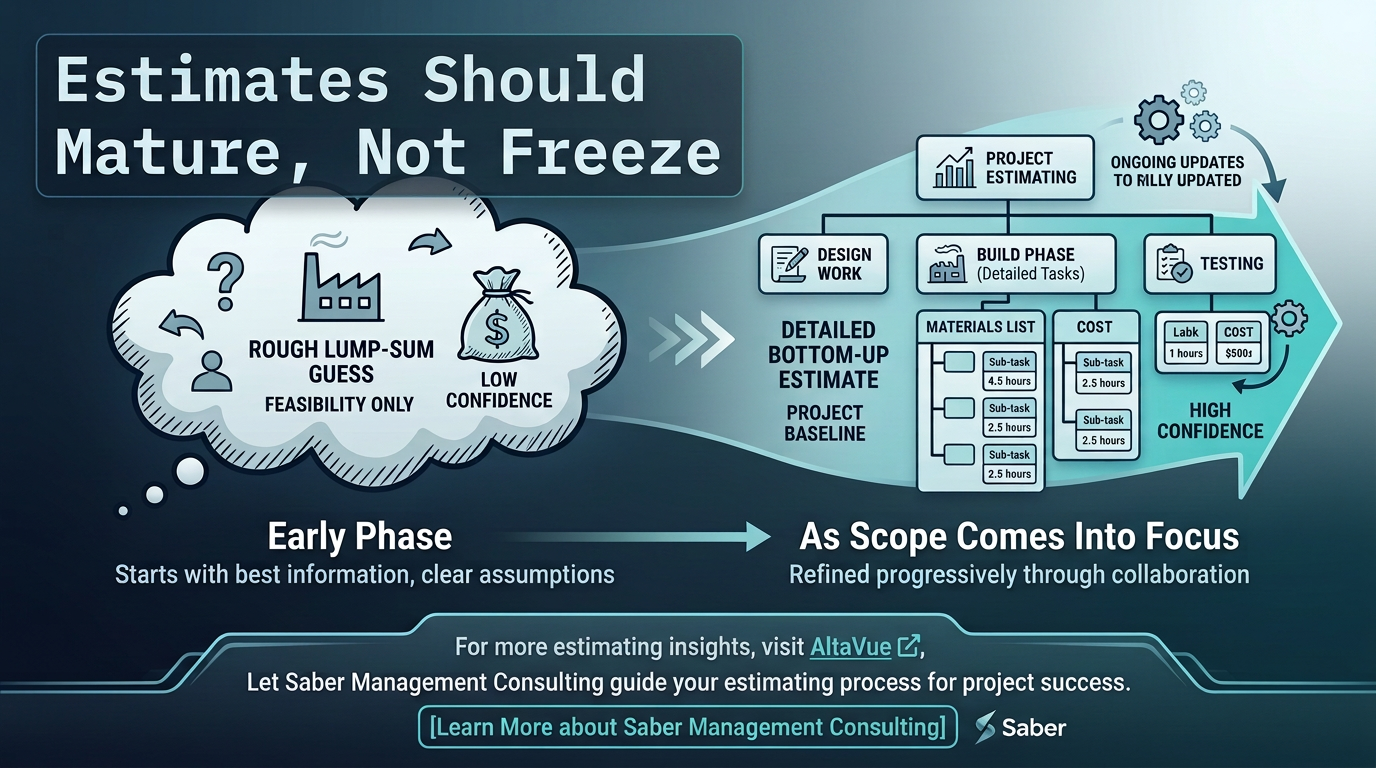
The answer is progressive refinement. Start with the best information you have, write down your assumptions, and be clear about how confident you are in the number. Then refine the estimate as the scope comes into focus. The estimate you use for early feasibility shouldn’t carry the same level of detail as the one you use to baseline the project. And the baseline estimate shouldn’t be treated as frozen forever if approved changes alter the work. Good estimating isn’t a one-time event. It’s a process.
When the Estimate and the Project Stop Speaking the Same Language
Another problem I see all the time is the disconnect between estimating and delivery. A company builds its estimate in Excel. The project gets approved. Somebody builds the schedule in a different tool, someone else sets up tasks in another system, and time gets tracked somewhere else entirely. Now there are several different versions of the same project, each using its own categories.
Then leadership asks, “Why are actuals running higher than the estimate?” and the project manager has to reconcile all of it by hand.
That’s one of the core problems we designed AltaVue to solve, and the idea behind it is simple: define once, use everywhere. Build the project structure one time and carry that same structure through the life of the project.
AltaVue Scope helps the team frame the project, identify stakeholders, define outcomes, build the scope, capture requirements, prioritize, identify risks, and set the baseline. That work produces exactly the structure you need to estimate intelligently. AltaVue Estimating then builds from that same WBS. You apply labor and billing rates, add direct and vendor costs, create estimate versions, review them, move the estimate through approval and e-signature, and export it when you need to.
Most importantly, you’re not starting over. You’re estimating the project you already defined.
That’s the part that matters. An estimate should be connected to scope, not floating next to the project as a separate document. If the WBS changes, you should see what that means for the estimate. If scope grows, you should see the cost. If a work package goes away, the estimate should reflect it. And when the approved estimate becomes the yardstick for actual performance, the categories should still mean the same thing months later.
That sounds basic. In practice, most organizations define the project in one place, price it in another, schedule it in a third, track it in a fourth, and spend the rest of the project trying to make the pieces agree. I’d rather start with one project definition and carry it all the way through.

Experience Is Good. Experience With Structure Is Better.
There’s another benefit to working this way: it makes estimating teachable.
A lot of small business owners will tell you they’re “not project managers.” But they estimate work constantly. They decide how many people a job needs, how long it will take, what to charge, what the vendors will cost, and whether the work is even worth pursuing. That’s project estimating, whether they call it that or not. The catch is that most owners do it from experience and gut feel.
Experience is valuable. It becomes far more powerful when it’s backed by structure, because a repeatable estimating process gives you something to compare against when the job is done. In the Army, we called that an after-action review: what was supposed to happen, what actually happened, why there was a difference, and what we’ll do differently next time. Applied to an estimate, that means asking where you were off. Did you underestimate labor? Miss a vendor cost? Assume the customer would provide something they didn’t? Forget testing, or lowball the review cycles?
That feedback sharpens the next estimate, and over time the whole business gets better at it. That’s what disciplined project management is supposed to do. Not create more paperwork. Create better decisions.
Do the Thinking Before the Math
So the next time someone asks, “How much is this project going to cost?” resist the urge to answer too quickly. Start with a different question: what exactly are we estimating?
If the team can’t answer that clearly, the estimate isn’t ready to become a commitment. Define the work. Break it down. Understand the assumptions. Price the work and review the risk. Then put a number on it.
The calculator should come after the thinking, not before it.