There’s one question I wish more executives would ask when someone presents an AI adoption report: “What changed in the business?”
Not how many licenses were purchased. Not how many employees finished the training. Not how many prompts got submitted last month. What actually got better?
Using the Tool Isn’t the Same as Benefiting From It
This has been on my mind because the AI conversation has moved so quickly from experimenting with tools to rolling them out across entire organizations. In October 2026, PMI announced a new partnership with Prosci focused on AI adoption, organizational change, and business value, and the research behind that announcement is worth paying attention to. Prosci’s 2026 State of AI Adoption study surveyed 1,553 workers in the US and UK and found that roughly two in three now use AI regularly at work. Yet the share of organizations getting the best results from AI hasn’t grown since 2024. (Prosci, 2026)
That isn’t evidence that AI doesn’t work. It’s evidence that people using a tool and the business benefiting from it are two different things. I’ve seen versions of this problem long before AI came along. An organization implements a new system, celebrates the go-live date, runs a few training sessions, and then quietly discovers the old process is still running right alongside the new one. The organization has more technology. The employees have more steps. Leadership has a prettier dashboard. And very little has actually changed.
When Activity Feels Like Progress
AI can make that problem worse, because it makes activity feel like progress.
Picture a 30-person electrical contractor that gives its estimators an AI assistant. The estimators love it. First drafts of bid narratives come together faster. Notes from site walks are easier to organize. The owner sees people using the tool and assumes the investment is paying off. Maybe it is.

But ask a few less comfortable questions. Are bids actually going out faster from start to finish, or are they sitting longer in review because someone has to check every assumption the AI made? Are estimate revisions down? Did the win rate change? Are handoffs into project execution any cleaner? Or did the hours saved on writing just move over to correcting errors?
If nobody measured the original workflow, the honest answer is probably a guess. That’s exactly where project management discipline belongs in the conversation.
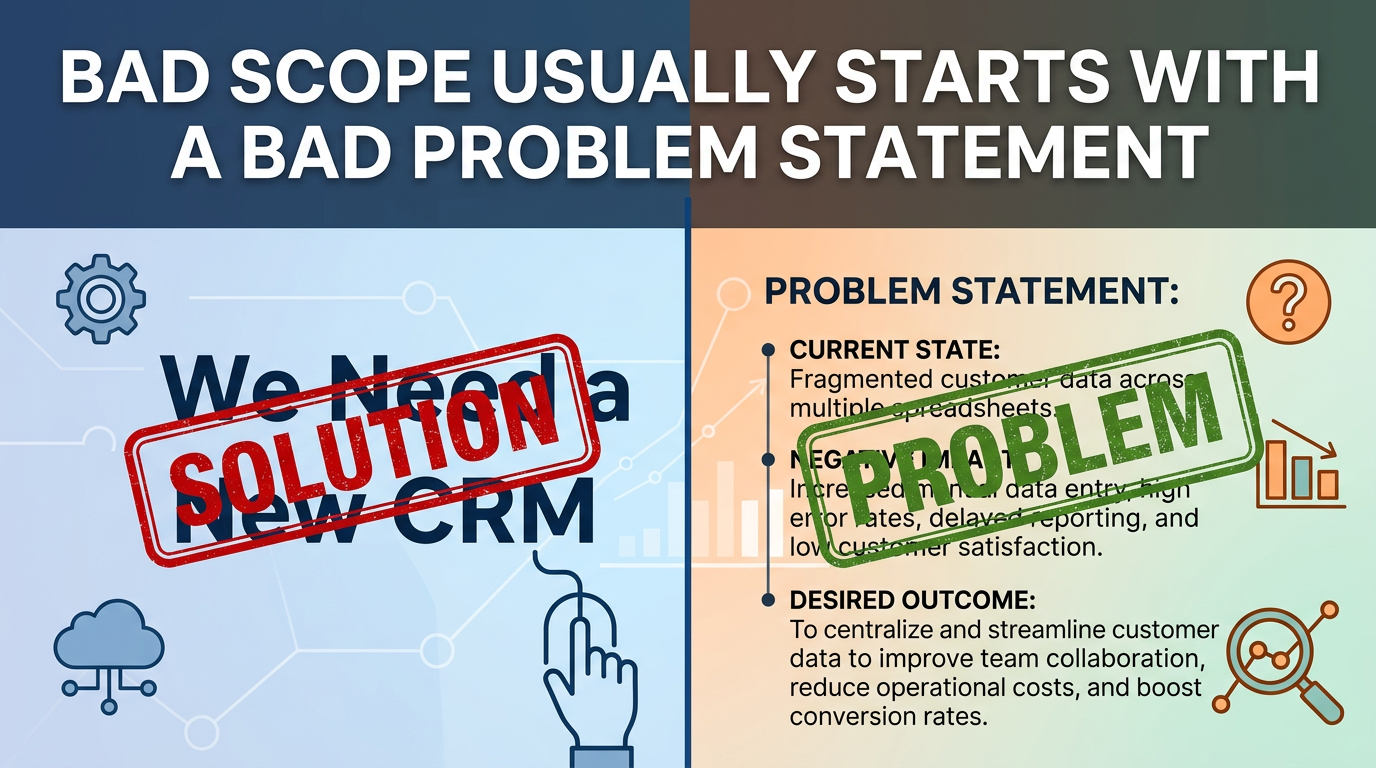
Start With the Work, Not the Software
Before you pick a tool, pick a business process that is both painful and measurable. Define where it starts and where it ends. Identify who does the work, where the information comes from, which decisions have to be made along the way, and what a good outcome looks like.
For the contractor, that process might run from receiving a bid invitation to submitting a reviewed estimate. An AI pilot that improves only the narrative-writing step may be useful, but it shouldn’t be confused with improving the whole process.
Measure What the Business Actually Cares About
Next, choose two or three measures that would genuinely matter to the business. Cycle time is one. Rework is another. Quality might show up as the number of corrections caught before a bid goes out, or the discrepancies found after award. Depending on the business, customer response time, labor hours, compliance exceptions, or employee workload might matter more.

The point isn’t to build a giant measurement program. It’s to keep from declaring victory just because a usage chart went up.
Name a Process Owner, Not Just an AI Champion
This is the step most organizations skip. They appoint an AI champion but not a process owner. The champion answers questions about the tool. Nobody owns the end-to-end result.
A process owner should be able to tell you what the new workflow is, where human review is mandatory, which tasks are no longer needed, how exceptions get handled, and whether the process is producing the outcome the business expected. That person doesn’t need to run a PMO.
In a small business it might be the operations manager, an estimator, the office manager, or the owner. What they do need is the authority to change how the work gets done.
Stop Doing the Old Work
The next step is uncomfortable but necessary: stop doing some of the old work.
If your staff uses AI to prepare a report and then rebuilds the same report by hand because leadership still wants the familiar format, you haven’t automated anything. You’ve layered new work on top of old work.
Sometimes there are good reasons to keep a control or a review step. But there should be a reason, an owner, and a clear understanding of what it costs. Habit alone isn’t a business case.
Check the Results After the Excitement Wears Off
Finally, go back and look at the results once the novelty has faded. I like a simple 30-day review. What was the baseline? What changed? What got worse? What did employees find themselves doing that nobody anticipated? And is the improvement repeatable without constant help from the person who introduced the tool?
That last question matters more than people think. A successful demonstration is not the same thing as a sustainable way of operating.
Prosci’s research raises one more point leaders shouldn’t ignore: executives and frontline workers see AI’s value very differently. That doesn’t prove which group is right, but it tells me the conversation is happening at two different levels. Leadership may be looking at enterprise adoption numbers and investment stories. Employees are looking at Tuesday afternoon and whether their actual work got any easier. Both perspectives belong in the review.
A Little Discipline, Not More Bureaucracy
I’m not arguing for slowing down every AI experiment with six committees and a binder full of approvals. Small businesses especially can’t afford that kind of bureaucracy. I’m arguing for a little discipline.
Pick one workflow and establish a baseline. Bring the people who actually do the work into the design conversation. Decide what must be reviewed by a human, and remove the steps that no longer earn their keep. Measure the outcome. If the result is better, scale it. If it isn’t, find out why before buying another round of licenses.
AI adoption is a useful indicator. It tells us people are trying something. It doesn’t tell us whether we made the business better.
A project manager, consultant, or business owner who can answer that second question is doing more than implementing technology. They’re managing change. And that’s where the return on the investment is supposed to come from.
If your organization has adopted AI but can’t yet point to what changed, Saber Management Solutions can help you connect the tools to real results. Saber is a veteran-owned project management consulting firm specializing in project recovery, operational efficiency, and strategic planning. Reach out at sabermgmtconsultants.com.