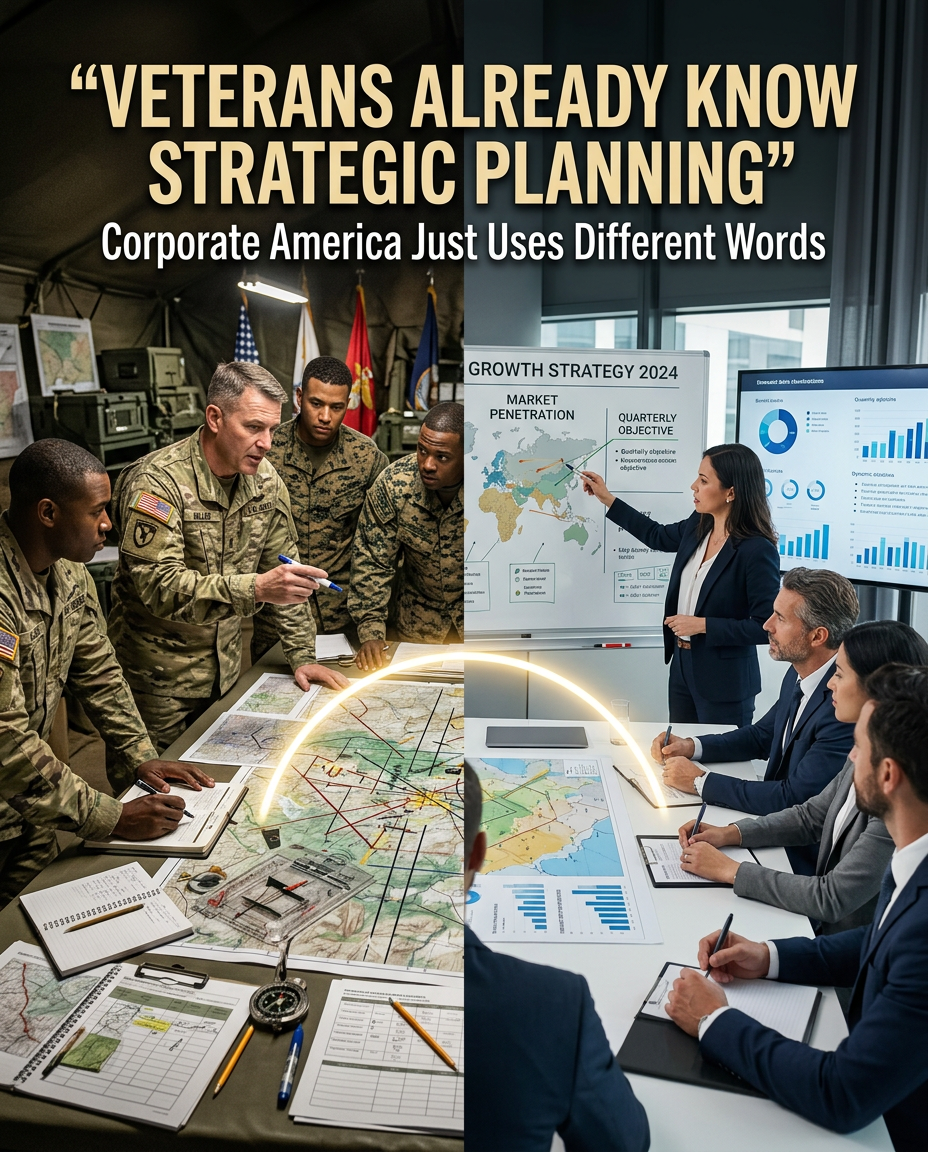
Veterans Already Know Strategic Planning — Corporate America Just Uses Different Words
Here is an opinion that I think will generate some disagreement:
A lot of veterans do not need to learn strategic planning from scratch when they enter corporate America.
They need to learn the corporate vocabulary for something they may already know how to do.
I spent 20 years in the Army. Later, I built a career in project management. The longer I worked in corporate environments, the more I noticed something interesting. Businesses often describe strategic planning as if it were a mysterious executive discipline.
- Mission.
- Vision.
- Strategic objectives.
- Operating environment.
- Risk analysis.
- Resource allocation.
- Scenario planning.
- Execution roadmaps.
- Performance measures.
- Contingency plans.
- Lessons learned.
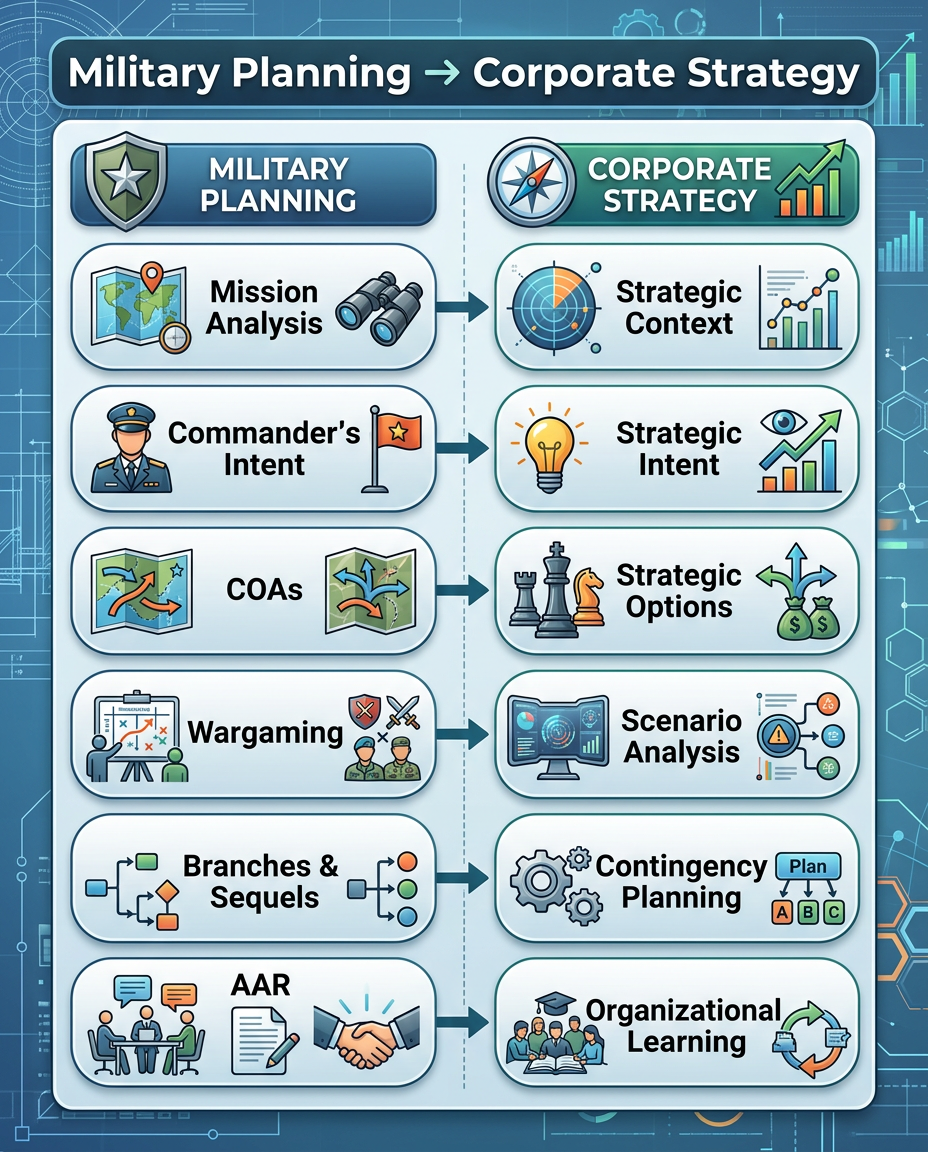
Veterans may recognize that list. We just used different words. Military planning teaches people to begin with the mission.
- What are we trying to accomplish?
- Why does it matter?
- What conditions must exist when we are finished?
Corporate strategic planning should begin exactly the same way. Unfortunately, many organizations begin somewhere else. They begin with initiatives.
- “We need to implement a new system.”
- “We need to enter a new market.”
- “We need to reorganize.”
- “We need to improve customer experience.”
- “We need to cut costs.”
Those may be valid initiatives. But they are not strategy. Strategy starts with understanding the mission and the environment before deciding what actions to take.
That leads to the first lesson veterans can bring into corporate strategic planning:
Understand the mission before building the plan. In the military, a plan without a clear mission is dangerous. In business, it is expensive.
Leaders should be able to answer:
- What are we trying to accomplish?
- Why now?
- What does success look like?
- What constraints exist?
- What cannot fail?
- What conditions would cause us to change direction?
If those answers are unclear, the organization is not ready to build an execution roadmap.
The second lesson is commander’s intent.
One of the most powerful concepts in military leadership is understanding not only what needs to happen, but why. The reason is simple. Plans rarely survive contact with reality exactly as written.
- Markets move.
- Customers change.
- Competitors respond.
- Vendors fail.
- Projects slip.
- Budgets change.
- Regulations appear.
- People leave.
- Unexpected opportunities emerge.
If employees only understand the task, they stop when the task no longer fits reality. If they understand the intent, they can adapt while still moving toward the desired outcome. Corporate leaders often say they want empowered teams. But empowerment without intent is just decentralization.
If you want people to make good decisions without waiting for approval every time, they need to understand the strategic intent.
That brings us to the third lesson: Develop multiple courses of action.
One thing that surprises me about corporate strategic planning is how often organizations fall in love with the first reasonable solution.
A leadership team decides what it wants to do. Then planning becomes an exercise in proving that decision was correct. That is not strategic planning.
Strong planning should compare alternatives.
- What are the viable courses of action?
- What are the advantages?
- What are the disadvantages?
- What assumptions does each depend on?
- What resources are required?
- What risks does each create?
- What happens if our assumptions are wrong?
This is where wargaming becomes relevant to business. No, I am not suggesting executives move toy tanks across a conference table. I am talking about disciplined scenario analysis. If we choose this strategy, what happens next?
- How will customers respond?
- How will competitors respond?
- What bottlenecks appear?
- What happens if demand is 30% higher than expected?
- What happens if it is 30% lower?
- What happens if our largest vendor fails?
- What happens if the implementation takes six months longer?
- What happens if the budget is cut?
Strategic planning gets much stronger when leaders stop asking: “Will this work?”
And start asking: “Under what conditions will this fail?”
That is a very different conversation.
The fourth lesson is branches and sequels.
Good military planning does not assume one linear future. Neither should corporate strategy.
Leaders should know:
- If this happens, what do we do next?
- If that assumption fails, what changes?
- If an opportunity appears, how do we exploit it?
- If a risk materializes, what is our alternative?
- Businesses love five-year strategic plans.
The problem is that the world does not care about the spreadsheet. A strategy should establish direction while preserving the ability to adapt.
The fifth lesson is resource reality.
Military planning teaches a basic truth: You cannot execute a mission with resources you do not have. Corporate strategic plans sometimes ignore this.
Leadership approves twelve strategic priorities. Every priority is labeled critical. The same six people are assigned to all twelve. Then executives wonder why execution is slow.
If everything is a priority, then nothing is.
Strategic planning should force resource choices.
- Where will we put our best people?
- Where will we put capital?
- What work will we stop doing?
- Which initiatives will wait?
- Which capabilities must be built?
Project portfolio management is strategy expressed through resource allocation.
The sixth lesson is rehearsal.
Military units rehearse because a plan that looks good on paper can fall apart during execution. Businesses should do more of this. Before launching a major transformation, walk through the plan.
- Who makes the first decision?
- What happens next?
- What system is involved?
- Where does the handoff occur?
- What happens if approval is delayed?
- What does the customer experience?
- What does the frontline employee experience?
- Where can the process fail?
That is business process optimization, risk management, and implementation planning happening before the organization pays the price for discovering those problems during execution.
The seventh lesson is the after-action review.
This may be one of the most transferable military practices of all.
- What was supposed to happen?
- What actually happened?
- Why was there a difference?
- What should we sustain?
- What should we change?
Businesses often call this lessons learned. Then they hold the meeting at the end of the project, write down the lessons, save the document, and repeat the same mistakes on the next project.
That is not organizational learning.
A real after-action process changes the next decision.
- It changes the next plan.
- It changes the process.
- It changes training.
- It changes governance.
Otherwise, it is just documentation. This is also where project recovery connects directly to strategic planning. A troubled project is often a strategic plan colliding with reality.
- The original assumptions were wrong.
- Resources were insufficient.
- Decision-making was too slow.
- The operating environment changed.
- Stakeholders were not aligned.
- The chosen course of action did not work.
Strong project recovery does not simply ask: “How do we get back to the original plan?”
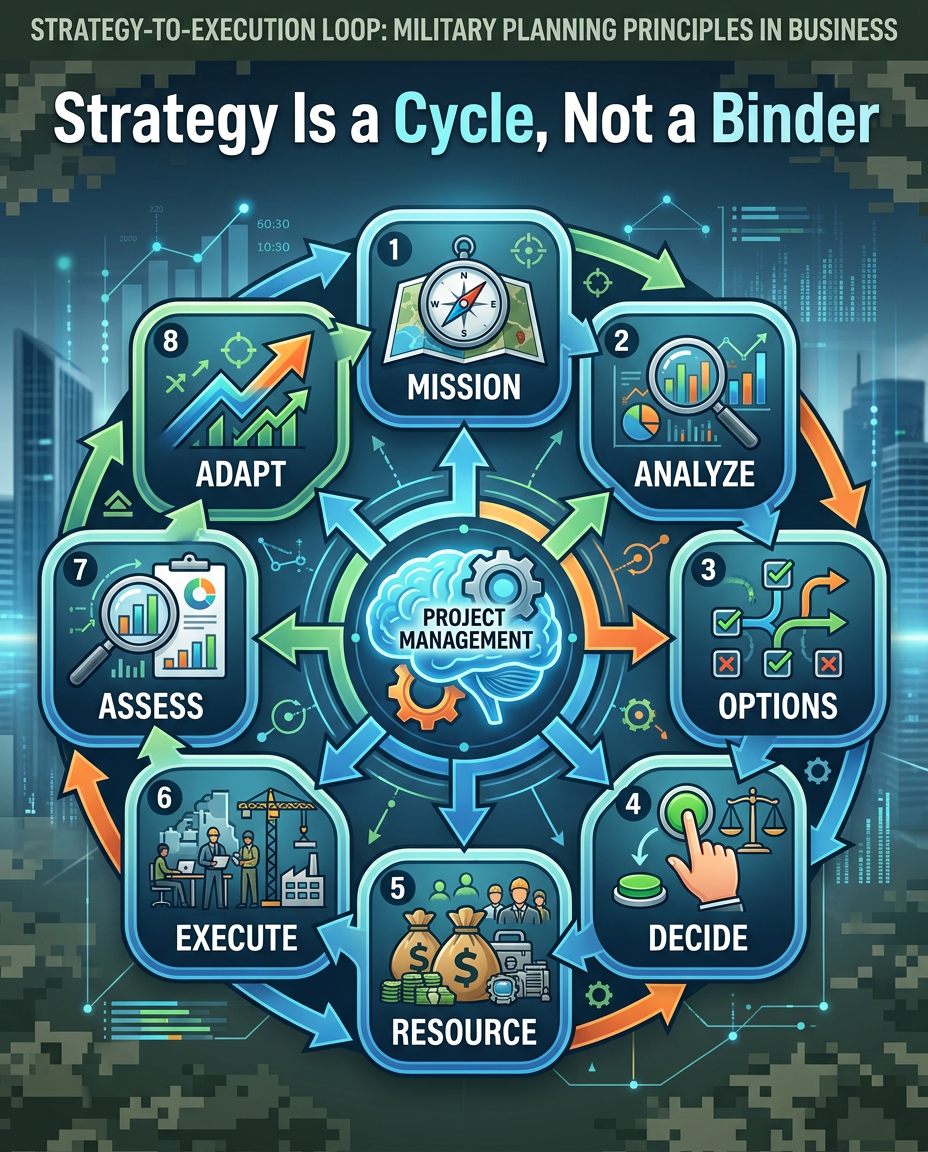
It asks: “What has changed, what have we learned, and what course of action now gives us the best chance of achieving the mission?” That is strategic planning.
AI can help here too. AI can analyze data. It can compare scenarios. It can surface patterns. It can model assumptions. It can help teams prepare multiple courses of action. It can summarize risks and identify information gaps.
But I would use AI the same way I would use a strong staff function. It supports the decision. It does not own the mission.
Human leaders still need to decide:
- What matters.
- What tradeoffs are acceptable.
- What risk to accept.
- What values cannot be compromised.
- What success actually means.
The future of strategic planning may include far more AI-assisted analysis. But strategy will still require judgment. That brings me back to veterans.
When veterans move into corporate careers, I think we sometimes undersell what military experience actually taught us.
We say:
- “I led people.”
- “I managed operations.”
- “I worked under pressure.”
Those things matter. But many veterans also learned how to:
- Analyze ambiguous environments.
- Translate intent into action.
- Develop alternatives.
- Manage risk.
- Allocate scarce resources.
- Plan contingencies.
- Coordinate across functions.
- Adapt when conditions change.
- Lead execution.
- Conduct honest after-action reviews.
That is strategic planning. The language changes. The fundamental discipline does not. Corporate America does not need veterans to abandon military thinking. It needs veterans to translate the best parts of that thinking into business language.
And businesses might benefit from listening.
Because one of the biggest problems in corporate strategy is not creating the strategy. It is turning strategy into coordinated action when reality refuses to follow the plan.
Veterans have some experience with that.